
Technology
The plant, explained.
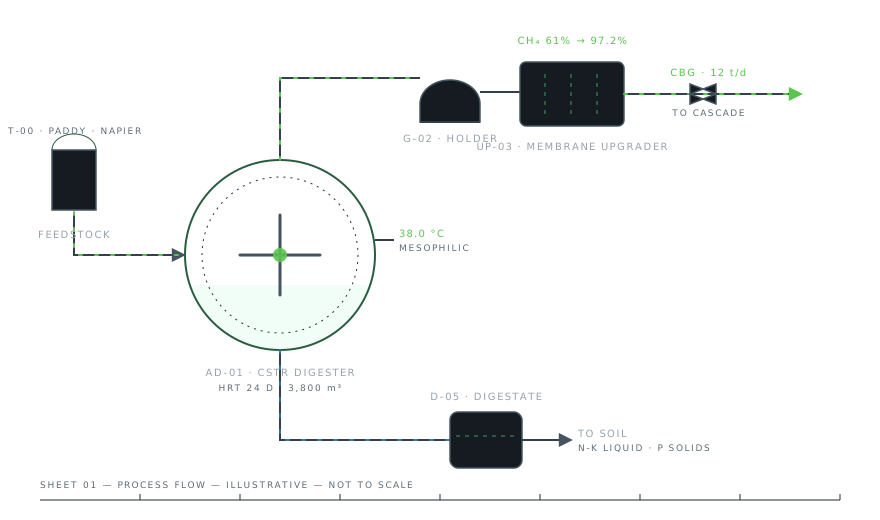
Every VSN plant is the same anatomy: intake, digestion, upgrading, compression — with digestate closing the loop back to the field. Here is what happens at each step, and the specifications we design to.
End to end
One residue, two products.
Feedstock enters once. It leaves as high-purity CBG and as organic fertilizer — nothing is vented, nothing is wasted, and every stream has a purpose.
The four streams
What each tonne becomes.
VSN's resource base is built on four feedstock classes, each with a distinct yield profile — and the digester mix is tuned to them.
Feedstock → CBG yield ranges (India, published studies)
| Feedstock | Biogas yield | Approx. CBG per tonne |
|---|---|---|
| Paddy straw | 200–350 m³/t | ≈ 55–60 kg |
| Pressmud | 50–90 Nm³/t | ≈ 80 kg (Kolhapur ref.) |
| Animal manure / dung | 20–40 Nm³/t | ≈ 16–20 kg |
| Napier grass (CO-4/CO-5) | 200–400 L/kg biomass | 85–95 kg optimized |
Sources: MNRE/GOBARdhan studies · Kolhapur 100-TPD pressmud reference · ICAR fodder trial data — compiled in research/FACTS-INDIA.md. Site-specific BMP tests precede every commercial design.
The vessel
Choosing the digester.
The tank follows the substrate. We run complete-mix CSTRs wherever feedstocks are blended — they forgive variation, which is the one constant in agricultural waste. High-solids streams suit plug flow; dilute streams suit lagoons; dry organics run in batch tunnels; and soluble industrial wastewater goes to high-rate UASB.
Temperature is the other decision. We default to mesophilic — 35–40 °C with 15–30 day retention — because stability pays: thermophilic runs (50–55 °C) digest faster but upset harder. For pathogen-sensitive feeds we step up, deliberately.
Sources: EPA digester types · peer-reviewed AD reviews
Digester types & use cases
| Type | Solids | Typical feed |
|---|---|---|
| CSTR (complete-mix) | 2–10% TS | Sludge, residues, co-digestion |
| Plug flow | 11–20% TS | High-solids dairy manure |
| Covered lagoon | <1–3% TS | Dilute flush manure, warm climates |
| Dry AD | 30–35% TS | Municipal organics (OFMSW) |
| UASB (high-rate) | <3–5% TS | Soluble industrial wastewater |
CBG quality & handling
| VSN product spec | > 96% CH₄ |
|---|---|
| BIS IS 16087 minimum | ≥ 90% CH₄ · CO₂ ≤ 4% |
| H₂S (total S) | ≤ 20 mg/m³ |
| Moisture | ≤ 5 mg/m³ |
| Compression | ≈ 250 bar cascade |
| Dispatch | Cascade cylinders · CGD / industrial offtake |
Sources: BIS IS 16087:2016 · PNGRB CBG integration paper 2025 · VSN corporate profile
Upgrading
From raw gas to CBG.
Raw biogas leaves the digester at 50–70% methane with 30–45% CO₂ and traces of hydrogen sulphide. India's BIS standard (IS 16087) sets the pipeline floor at 90% methane; VSN's product specification is over 96% — enrichment beyond the national minimum — after which it is compressed for dispatch.
Four upgrading routes get it there: water scrubbing (≈97% CH₄ product, ≈98.5% recovery — our default), pressure swing adsorption (92–98%, strong Btu compliance), membranes (88–99.5% purity, compact footprint), and amine scrubbing for the tightest specs.
The upgraded molecule is energy-dense: ≈10 kWh per m³ — 36 MJ/m³. Compressed to roughly 250 bar it becomes CBG — a direct, drop-in substitute for fossil CNG in vehicles and industrial burners.
Outputs
Gas, and fertilizer.
In this design the entire biogas stream is upgraded to CBG — every cubic metre goes to the product, none to on-site power. And the digester's other output feeds the soil.
Energy in every cubic metre of upgraded biomethane — 36 MJ/m³, the workhorse molecule of the platform.
IEA · Outlook for Biogas & BiomethaneCBG dispatch pressure — compressed and cascade-filled for direct industrial and automotive offtake, no engine hall required.
CBG industry practice · IS 16087VSN's CBG product specification — high-purity biomethane for industrial and automotive applications.
VSN Green Energy corporate profileThe loop closes
Digestate is not waste.
Digestion consumes carbon, not nutrients. What leaves the digester carries nearly all the nitrogen, phosphorus, and potassium that came in — in a form plants take up more readily than raw manure.
The liquid fraction is an N–K fertilizer whose ammonium share runs 44–81% plant-available, versus about 35% in raw manure. The solid fraction is a phosphorus-rich amendment. Field studies show digestate partially or fully replaces synthetic NPK at equal or higher yields — which is why every VSN plant returns it to farming soil, restoring fertility acre by acre.
Sources: Möller & Müller 2012 · Frontiers in Sustainable Food Systems 2024
Digestate composition (per tonne, fresh)
| Total nitrogen | 1.2–9.1 kg/t · 44–81% as NH₄⁺ |
|---|---|
| Phosphorus | 0.4–2.6 kg/t |
| Potassium | 1.2–11.5 kg/t |
| pH | 7.3–9.0 |
| Liquid fraction | N–K fertilizer |
| Solid fraction | P-rich soil amendment |
The chemistry is proven.
The platform is being built.
Process engineering · feedstock trials · plant commissioning